Saturday Snapshot: Outside the George & Vulture, City of London

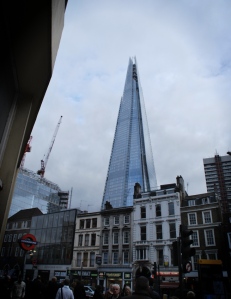
In a new and ENTIRELY ORIGINAL feature I arbitrarily choose a day of the week and a suitable alliteration to bring you vignettes of travel past and present. Today it’s the SATURDAY SNAPSHOT and we’re outside the George and Vulture pub in the City of London.

Something witty

The George and Vulture is one of those old London boozers that you find hidden away in backstreets. Allegedly there’s been an inn here since 1268 (thank you Wikipedia) but the current establishment was built in 1748. It’s heavily featured in Charles Dickens’ novel The Pickwick Papers and still retains a strong link to the Dickens family. 

Something equally witty

Being in the City of London  of course this place hosts archaic and utterly ludicrous groups for dinner. For those not up on their London Boroughs, the City of London isn’t one. Administratively it’s an entirely separate city and authority which, confusingly, sits in the middle of the Greater London Authority. You may also know it as The Square Mile, or simply “the city.” Anyway, whilst the GLA worries about things like transport, poverty, crime and other urban things, the City of London Corporation – serving the 7,000 inhabitants of the city and the 350,000 people who work there – is composed of such groups as the The Worshipful Company of Bowyers, whose website tells us that: “the Worshipful Company of Bowyers can trace its detailed history back to 1363 when the craft of making longbows first appeared on the list of taxation for the City of London.” As I’m sure we can all agree, making longbows is pretty important. The City also has something to do with finance and helping people to make money, but since 2008 we don’t talk about that.

But on the other hand, the City of London does have a pretty wicked crest - a dragon with a St George's Cross - and it's everywhere. So: swings and roundabouts.

But on the other hand, the City of London does have a pretty wicked crest – a dragon with a St George’s Cross – and it’s everywhere. So: swings and roundabouts.

Something even wittier

London is full of these little gems of history that you often stumble upon quite by accident. I remember at one of my old places of work, on Fleet Street, there was a fire alarm and we had to leave the building by a door I’d never gone through before. It exited us into a little courtyard and there, on the wall in front of me, was a little blue plaque telling me that James Boswell,  18th century author of the London Journal and the Life of Johnson, had lived there. Amazed at this litte  slice of history I’d uncovered, I pointed it out to one of my colleagues. He stared in silence at the plaque for a moment, obviously as moved as I was, before saying: “that’s amazing. Now can we go back inside? It’s bloody freezing.”

The WalkFast Philosophy: Commuting in London (Travels in 2012, Part 4 of 4)

Object 4: A 1960s Soviet Fed4 Camera. No I have no idea what all the knobs on the top are for either.

Object 4: A 1960s Soviet Fed4 Camera. No I have no idea what all the knobs on the top are for either.

What has a 1960s camera made in the USSR got to do with commuting in London? Absolutely nothing. Except for the fact that it actually made me take a closer look at my everyday travels. And take some really dodgy photos of London. Let’s call them vintage.*

Some would call it scraping the barrel, I would call it being innovative. Whatever your views on blogging about the daily commute, the journey to work is one we all have to make. (Unless you’re one of those people who make a living by writing witty and/or informed and/or misleading articles about the next best travel destination whilst sipping margaritas next to a beautiful white sand beach; if that sounds like you, then please stop reading now. This really isn’t for you). Even if you work at home, we all have some regular journey of drudgery. Perhaps yours is to the gym or the supermarket. Mine is the daily commute into Central London.

One of the Fed4 photos....

Sometimes I take do take the underground, but mostly I take the train. It’s like the underground, but better.

Picture the scene: it’s the 07:42 into London Waterloo. The carriage is full, but not uncomfortably so. People are standing in the aisle between the seats but people can still step onto the train without having to plant their face into someone’s armpit. People either read, fiddle with their smartphones or stare out the window. As ever, no one talks. The only permissible human interaction is to ask for a window to be opened. But it’s not silent, because a man is listening to his music at an unconscionably loud volume. He’s listening to Jay-Z. It’s offensively loud. I am standing right next to where he is sitting, pretending to read a magazine whilst internally raging against this stranger and his music. He writes a text to someone. I read it over his shoulder. This is what it says:

Don’t think that the stuck up fuckers on this train are enjoying me playing my Jay-Z at full volume. Oh well!

I am a cauldron of hatred and resentment. I stare blankly at my magazine, fantasising about how I might say something to the man and how the rest of the carriage would join in to support me, moved by my stirring words and my willingness to stand up against the tyranny and oppression of loud music. Twenty minutes pass like this; then we reach London Bridge, my nemesis gets off and I have said nothing. Instead I update my facebook status to share my frustration. Three people like it almost immediately. I still can’t help but feel that I lost.

Fed11

PERHAPS THREE weeks later I am standing on the 507 bus from Waterloo, also on my daily commute. A girl with ipod-white earbuds is standing in front of me, sharing her R&B music with the rest of the bus. I ignore her. A woman seated nearby taps Ipod-girl on her arm and, in an Aussie accent, asks her to turn down her music.

“Is it bothering you?” asks Ipod-girl.

“As a matter of fact it is,” replies the woman, “and it’s bothering everyone else on the bus as well, it’s just that they’re all British and so they’re too polite to say anything. But I’m Australian, and I am not too polite.”

Ipod girls turns her music down.

In my mind I am cheering for this Australian woman, this commuters’ champion. It’s victory for all that is good and just in the world. But I say nothing, give nothing away. Perhaps because I’m British, this is London and she’s a stranger.

Officially, the only time that you're permitted to speak to a stranger in London is when it snows. Usually in this instance, it's to share frustration about the disruption to transport.

Officially, the only time that you’re permitted to speak to a stranger in London is when it snows. Usually to share frustration about the disruption to transport.

something

I sometimes forget the thick skin that you develop in London. Recently, family from out of town came to visit. When we met them at our local station they looked shellshocked. “We’ve been up and down I don’t know how many escalators,” they said, “and there are so many people, everywhere, walking so fast and all going to different directions.” Yup, I thought, ThisIsLondon: I do this everyday.

But sometimes something happens to break down that barrier that Londoners put up against everyone else. Snow brings people together. After all, it's hard to ignore someone when they're throwing a snowball at you.

But sometimes something happens to break down that barrier that Londoners put up against everyone else. Snow brings people together. After all, it’s hard to ignore someone when they’re throwing a snowball at you.

The advantage of a sledge as a mode of transport is that there's not going to be someone listening to loud music behind you.

The advantage of a sledge as a mode of transport is that there’s not going to be someone listening to loud music behind you.

LONDON LIVING makes you rush everywhere. I don’t know why, it just does. Walk fast, weave through crowds, dodge tourists. Always ignore the world-class history and architecture around you – that’s for the tourists. And they walk SLOW. You don’t want to be like them, do you? You might miss your train.

There are two incidents that have made me question this WalkFast philosophy. The first cost me a suit. The second cost me my dignity.

I was late to a meeting. I can’t even remember what it was about, but it was terribly important. So I was running, running past the Houses of Parliament to my meeting.

BigBenByNight

Unlike in this photo, it was the middle of the day. There were tourists everywhere, gawking at Parliament and Big Ben. As I dodged inbetween them, I slipped – unsurprising considering that I was running in a pair of leather soled shoes with as much grip as an air hockey puck. Tourists flashed before my eyes as I fell headlong to the floor, skidding on the writing pad I was carrying and sending my papers flying. “Great dive dude!” someone shouted in an American accent. My suit was ripped in three places. I had lost some buttons. A crowd formed around me and a German man helped me up, telling me in impecable English how his 11 year old son did something similar last week whilst ice skating. There wasn’t any ice here, though, he added. I thanked him, collected my papers, and scurried off. I was the first person to arrive at the meeting.

London people are busy people. Stay out of their way, tourists! Unless they fall flat on their face. In which case, please help them up and don't comment on the quality of their dive or how stupid they look. Thank you.

London people are busy people. Stay out of their way, tourists! Unless they fall flat on their face. In which case, please help them up and don’t comment on the quality of their dive or how stupid they look. Thank you.

The second incident happened equally as quickly. I was at Waterloo station, on my way home, rushing for a train (are you detecting a theme here?). My train was at the platform, I was not. There was another one soon, but that was seven minutes away. I ran for the train; I was nearly there, then the doors started to beep to warn that they were closing, but I was going to get on that train; the doors started to close; I jumped on, got trapped in the doors as they were closing, and forced them apart again. I stepped into the carriage, out of breath but triumphant. Everyone was staring at me. The train doors tried to close again to allow it to depart but one of them got stuck because some idiot had forced them apart when they were trying to close. I felt the eyes of everyone in the carriage boring into me. I leaned over, gave the doors a shove, and they closed. And suddenly it hit me: I WAS THAT GUY. I was that guy who was too impatient to wait, so self-important that I delayed an entire trainload of people from departing and forced myself onto the carriage. I might as well have been listening to my music at full volume.

I got off at the next station. No one said anything to me, but I knew what they were thinking while they pretended to read their magazines. Because I’d thought it myself a million times about others.

So now on my commute I try and walk a little slower, look at my surroundings a little more and speak to strangers where I can without looking like a lunatic. All in all, I’m trying to be a bit more of a tourist. I find that a camera helps with that.

Red phonebox

*In case anyone’s interested: the Fed4 pictures featured on this post were developed in matt with a white border and then simply scanned in. For the most part I haven’t applied any filters or tweaked them in any way, as I normally do. I haven’t totally figured out how to use the camera yet. That’s why the images are so… 1980s family holiday.

Old & New in Berlin (Travels in 2012, Part 3 of 4)

Object 3: An Antique Writing Set

Object 3: An Antique Writing Set. Obviously.

WHY WOULDN’T you buy a 1936 solid marble writing set when abroad and bring it home?  You’d think that I’d have learnt, after carrying a 2kg piece of carved slate from Belize all the way around Mexico and Guatemala only to find at the airport that it had broken in two. Before confiscating the slate the cheerful airport official helpfully pointed out that the razor-sharp edge created by the break could be used to cut someone’s throat. Frankly I was glad just not to be carrying it anymore. I’m pretty sure that she recognised my tears as an expression of relief, rather than frustration. Anyway, I thought, as I lugged the writing set back to the hotel, they’re surely not as hot on rules in Germany as in Guatemala…

It’s remarkable and somewhat shameful that at 28 years of age and living in the UK I had never visited Germany, the most populous country in the EU and the economic giant of Europe. When I first heard one of my former housemates talking about the amazing time that they had it Berlin, I remember being surprised because in my mind Berlin was some kind of depressed, concrete hell, with everything in sepia – basically Soviet-era East Germany.

Which just goes to show how wrong you can be about a city. I blame too many Le Carre novels.

Which just goes to show how wrong you can be about a city. I blame too many Le Carre novels.

Anyway, Berlin is now in my top 5 cities in the world. Here are some reasons why:

Hands down, Berlin has the the best green men the world over. I am obviously not the only person to think this, as there are shops all over the city devoted to the luminous fellow where you can buy extortionately priced "ampellman" merchandise. No wonder the German economy is surging whilst the UK economy is sputtering; in London there are shops full of Will & Kate merchandise. I know which I'd rather take home.

Hands down, Berlin has the the best green men the world over. I am obviously not the only person to think this, as there are shops all over the city devoted to the luminous fellow where you can buy extortionately priced “ampellman” merchandise. No wonder the German economy is surging whilst the UK economy is sputtering; in London there are shops full of Will & Kate merchandise. I know which I’d rather take home.

There's history and stuff! And it's not all about World War 2 or the Cold War! A lot of the history is covered in (what I understand to be) world class museums. Unfortunately we didn't visit any of them because we were there in July, it was wall to wall sunshine, and the museums are a) all inside and b) not beer gardens. See picture below.

There’s history and stuff! And it’s not all about World War 2 or the Cold War! A lot of the history is covered in (what I understand to be) world class museums. Unfortunately we didn’t visit any of them because we were there in July, it was wall to wall sunshine, and the museums are a) all inside and b) not beer gardens. See picture below.

The Germans do beer gardens really well. I mean, world class. This biergarten was in the big park in the centre of the city, next to a lake and was filled with people of all ages - including families. It had a great sense of community, a great sense of people coming together and drinking beer, and not a single act of violence or anti-social behaviour. In other words, everything that drinking in the UK is not.

The Germans do beer gardens really well. I mean, world class. This biergarten was in the big park in the centre of the city, next to a lake and filled with people of all ages – including families. It had a great sense of community, a great sense of people coming together and drinking beer, and not a single act of violence or anti-social behaviour. In other words, everything that drinking in the UK is not.

There's a massive park in the middle of the the city, called Tiergarten. Winding trails, tall trees, cyclists, walkers, families and naked old men. Yes, the last was a shock. On hot summer days people sunbathe nude in the park. My advice: be careful with the telephoto lens. People can get the wrong idea.

There’s a massive park in the middle of the the city, called Tiergarten. Winding trails, tall trees, cyclists, walkers, families and naked old men. Yes, the last was a shock. On hot summer days people sunbathe nude in the park. My advice: be careful with the telephoto lens. People can get the wrong idea.

In Berlin, people are really serious about their breakfast. They often go out for their first meal of the day, and they do it well. Lazy coffees, delicious bagels and an abundance all things things delicious. I don't speak German, so I spent the first two days wondering what this Frühstück was that everywhere was advertising and where I could get some of it to eat. Obviously, I am an idiot.

In Berlin, people are really serious about their breakfast. They often go out for their first meal of the day, and they do it well. Lazy coffees, delicious bagels and an abundance all things things delicious. I don’t speak German, so I spent the first two days wondering what this Frühstück was on menus and where I could try some of it. Obviously, I am an idiot.

For lots of reasons – and not just the Fawlty Towers one – Berlin is a city acutely aware of its own history, and does a lot to remember the past. But it feels like a city full of futures (mind you, coming from Britain any city that has public transport that runs on time feels vaguely futuristic. UK public transport is less futuristic, more optimistic). It’s hip, it’s international and it has something for everybody. While we were there we did history at the Berlin Wall, trendy bars in Prenzlauer Berg and top end dining in Kurfürstendamm. And compared to any other European capital I’ve been to it’s cheap.

I promise that I’m not on commission from the Berlin Tourist Board.

I always say that nothing brings history alive quite like a man with a flag who's painted his face and clothes silver. Without that, it's just  a bunch of dates, you know?

I always say that nothing brings history alive quite like a man with a flag who’s painted his face and clothes silver. Without that, it’s just a bunch of dates, you know?

It was really remarkable how they made that model car float on top of the fountain. The building on the right is where Angela Merkel works, apparently. She didn't invite us in for Frühstück.

It was really remarkable how they made that model car float on top of the fountain. The building on the right is where Angela Merkel works, apparently. She didn’t invite us in for Frühstück.

Yes, I did buy a piece of concrete purporting to be a piece of the wall. I got certificate and everything. Fortunately, I managed to make my money back by flogging this brick to a credulous British tourist.

Yes, I did buy a piece of concrete purporting to be a piece of the wall. I got a certificate and everything. Fortunately, I managed to make my money back by flogging this brick to a credulous British tourist.

The Wall is covered in art. Like all good art, it's truth that gives it power.

The Wall is covered in art. Like all good art, it’s truth that gives it power.

The standard of graffiti is a little bit higher than I'm used to in London. Obviously I tagged this after taking the photo.

The standard of graffiti is a little bit higher than I’m used to in London. Obviously I tagged this after taking the photo.

Sort of how I imagined Berlin to be before I heard others raving about it.

Sort of how I imagined Berlin to be before I heard others raving about it.

We saw The Future on the streets of Berlin: bar codes on pavements.

We saw The Future on the streets of Berlin: bar codes on pavements.

THERE’S SOMETHING that I need to get out of the way: stereotypes. It’s never good to rely on national stereotypes at the best of times, but visiting Berlin I realised that growing up in Britain had filled my mind with cultural stereotypes of Germans.

None of the popular British stereotypes of Germans were borne out in Berlin: humourless? Blown right out of the water by our joking with staff on the hotel reception and just about everyone else to whom we spoke. Sticklers for rules? Maybe, but I certainly wasn’t the only one eating eating on the metro (I only found out later that it wasn’t allowed!). Efficient? Er, yes, actually this one was true, but I was very happy for all my trains to arrive on time. Can’t queue? Actually, this is a stereotype that the British have about every other nation in the world. AND IT’S TRUE! Three times in queues in Berlin I got hustled by the people behind me: they weren’t being rude, they just quite clearly wanted to be standing where I was. At one point at our hotel’s breakfast buffet I nearly turned around and said something to the woman behind me in the queue for the Muesli. Unbelievable.

Sometimes, stereotypes tell us just as much about ourselves, as those we are stereotyping.

I also found that an unexpected stereotype of mine was challenged in Berlin: kebabs. During my pre-reading for the trip I was shocked to see that a full page photo in the Lonely Planet City Guide to Berlin was devoted to a picture of a man carving a doner kebab. Like this:

Something about kebabs

In Britain kebabs are what you have at the end of the night, when you’re too drunk to care that you’re eating horsemeat and goodness knows what else. They are not something that the gourmets go for. In Germany, Berlin especially, they are something that you go out and enjoy on a lunchtime when sober. This difference is a phenomenon of the large immigrant Turkish population in Berlin and the rest of Germany, dating back to the 1960s. Turkish immigrants brought their own cuisine with them and doner kebabs became a speciality. I’m not entirely sure why there’s such a qualitative difference in cultural and cuisine terms between the kebabs in Germany and the rest of Europe, but I could speculate that because there’s such a large, distinctive Turkish population in Germany with which kebabs are associated, they came to be an important cultural marker and hence quality was of greater importance. Plus, there are simply more Turkish people eating them and hence driving up expectations. If you go to Green Lanes in north London, where there is a large Turkish community, you’ll also find kebab shops open in the middle of the day and doing a roaring trade.

The photo above is not mine – I stole it from a now defunct blog called “Berlin Study Abroad” which can be found here. I came across it whilst searching for an image of a kebab. The first line of the post that I took the image from reads: “Recently I have found a heavenly food called a Doner Kebab.” If I wrote that in Britain it would be ironic. In Berlin it’s genuine. When I was there, I had the best kebab and falafel that I’ve ever had, world over. Now that’s a stereotype that I didn’t expect to have challenged in Berlin.

ALL IN all, Berlin has a wealth of things to commend it. So is surprising that I wanted to bring a little bit it back with me?

We'd learnt from the Belizean slate: this time, the heavy memento of a place went in the main luggage, not the hand luggage.

We’d learnt from the Belizean slate: this time, the heavy memento of a place went in the main luggage, not the hand luggage. It now sits next to my computer, gathering dust, its inscription in German indecipherable to me beyond the date. But every time I look at it I’m reminded of why it makes me happy to write about the places that I’ve been.

Ausgang

Travels in 2012 (Part 2 of 4): A Plastic Union Jack in Devon

Object 2: A Plastic Union Jack**Ok pedants, let's get this out of the way: I know that it's technically only the Union Jack when it's flown on a ship (otherwise it's just the "Union Flag") but everyone calls it the Union Jack, so I'm going to call it that that too. The only time this fact ever emerges is either in pub quizzes or at particularly slow parties where conversation is sparse ("actually, did you know..." If you're at a party and someone begins a sentence with this phrase, it's probably best to cut your losses). Wikipedia totally backs me up on this point: "The Union Flag, commonly known as the Union Jack, is the flag of the United Kingdom." And Wikipedia's, like, always right. Right?

Object 2: A Plastic Union Jack*
*Ok pedants, let’s get this out of the way: I know that it’s technically only the Union Jack when it’s flown on a ship (otherwise it’s just the “Union Flag”) but everyone calls it the Union Jack, so I’m going to call it that that too. The only time this fact ever emerges is either in pub quizzes or at particularly slow parties where conversation is sparse (“actually, did you know…” If you’re at a party and someone begins a sentence with this phrase, it’s probably best to cut your losses). Wikipedia totally backs me up on this point: “The Union Flag, commonly known as the Union Jack, is the flag of the United Kingdom.” And Wikipedia’s, like, always right. Right?

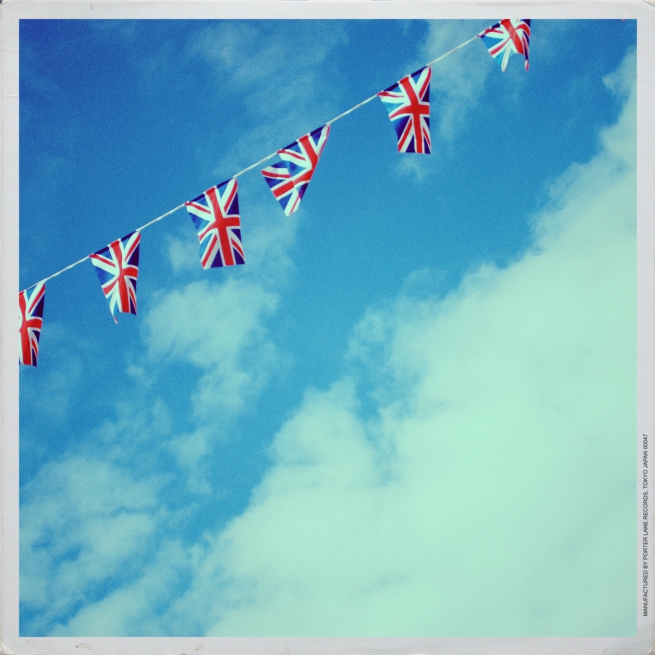
YES, 2012 was a special year for the Union Jack, its big outing. Sure there had been that Royal Wedding thing back in 2011, but that was really just practice for the Main Event. The Diamond Jubilee. Oh yes and the Olympics, that was happening too. Man there was going to be so much flag waving! And all the the little Union Jacks, all in a line, flapping along as bunting. It made an old Jack smile just to think of it. All over the UK, the Union Jack snapped back and forth in the wind. Well actually, it mostly hung in a damp kind of way, twitching limply in the drizzle. But in its mind, it was flying straight and true.

They grow up so quickly...

They grow up so quickly…

THE BEGINNING of June 2012 was special for those of us living in the UK, because we all got an extra bank holiday in honour of the Queen’s Diamond Jubilee. This was combined with a bank holiday that usually happened at the end of May but had been moved to June to make a Super Mega Weekend of four days. As is traditional for bank holidays, it rained throughout. London was the epicentre of it all, culminating in a Royal Regatta down the Thames with all the Royal Family in attendance. What a treat.

Naturally my partner, Beckie, and I decided to leave London, to escape the Jubilee madness. After consulting transport information, road atlases, the stars and a palm reader, we decided that the most auspicious time to leave this city of 8.2 million people would be the Friday evening before the beginning of the four day weekend. What could possibly go wrong?

The advantage of this plan, I discovered, was that it mitigated the risk of the car breaking down. How? Because when you’re stationary, it doesn’t matter whether your engine works or not. The car didn’t break down, but if it had, we could have pushed it all the way to Devon and we’d still have got there at the same time. We finally arrived SEVEN AND A HALF HOURS LATER.

Rather than staying in a hotel, we were house sitting. Which is to say, we have friends who live in Devon who were on holiday during the Jubilee weekend, and we invited ourselves to stay at their house. When we arrived we were met with a note apologising because they hadn’t had time to clean the oven for our arrival. We have never cleaned our oven. In my entire life, I think that I have only ever cleaned an oven once, and then under duress.

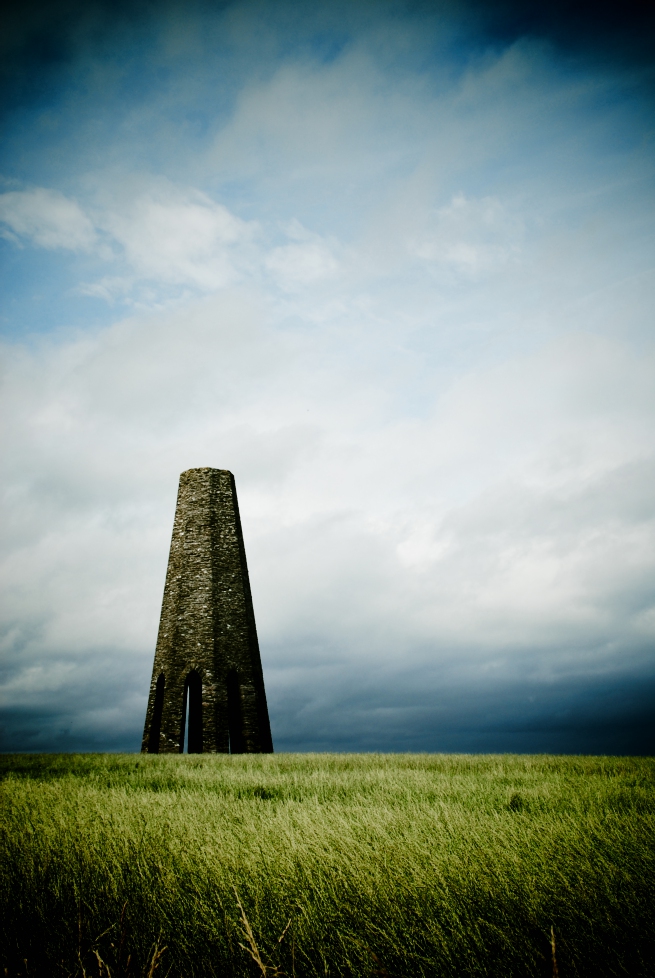
Rather than staying in a hotel, we were house sitting. Which is to say, we have friends who live in Devon who were on holiday during the Jubilee weekend, and we invited ourselves to stay at their house. When we arrived we were met with a note apologising because they hadn't had time to clean the oven for our arrival. I have never cleaned our oven. This picture of a nearby structure of ambiguous history and utility - such as are found scattered across the south west of England - was actually taken the year before, when we'd last stayed with them. Then it was sunny. During the jubilee weekend it rained perpetually. Whenever I walked in the house and saw my muddy footprints, all I could think of was the dirty oven. Don't clean your oven when I come to stay? Don't expect me to wipe my feet. No sir.

This nearby structure of ambiguous history and utility I actually photographed the year before, when we’d last stayed with our friends in Devon. Then it was sunny. During the Jubilee weekend it rained perpetually. Whenever I walked in the house and saw my muddy footprints, all I could think of was the dirty oven. Don’t clean your oven when I come to stay? Don’t expect me to wipe my feet. No sir.

IF WE thought that in leaving London, we were leaving the Jubilee celebrations behind, we were wrong. Devon is a place of winding, single track roads, hemmed by ten foot hedges. We’d round a blind corner (which is every corner on every road in Devon) to discover that we’d entered a small village or hamlet – every single one bedecked in bunting and Union Jacks. For those non-Brits reading this, please understand how odd it is for us (or how odd it was before 2012 anyway) to have flags anywhere. We’re not like North America, where everyone has a flagpole in their garden. Once, when I was on business in the US, I mentioned to one of my US colleagues that I”d heard that some people in the US wanted a constitutional amendment to prevent flag burning. He nodded vehemently, and proudly showed me a picture of the flag that he has hanging outside the front of his house. “It just makes me mad when I see flags that are all raggedy,” he told me, “when people just aren’t caring for them. I think, have you no pride?” He was driving at the time, and stared moodily at the road, no doubt picturing all the injustices that flags were suffering around the world, before adding: “If I saw someone right now setting light to a flag by the side of the highway, I’d stop this car, get out and punch them.”

In Britain, we have a different relationship with our flag.

Plastic Union Jacks are excellent at keeping you dry when it's raining. In fact, this particular bum-saver was actually one of many distributed in the Olympic park during the 2012 Olympics. We never even had it in Devon. So how can it be the object of my post for Devon, you ask? Well, it was raining in Devon, there were lots of flags and, more importantly, the Jubilee weekend and the Olympics have come to be the same thing in the popular consciousness, eliding the gap in time between the two events. See my helpful chart below, which explains this phenomenon.

Plastic Union Jacks are excellent at keeping you dry when it’s raining. In fact, this particular bum-saver was actually one of many distributed in the Olympic park during the 2012 Olympics. We never even had one in Devon. So how can it be the object of my post for Devon, you ask? Well, it was raining in Devon, there were lots of flags and, more importantly, the Jubilee weekend and the Olympics have come to be the same thing in the popular consciousness, eliding the gap in time between the two events. See my helpful chart below, which explains this phenomenon.

JubilympicsAnyway, thanks to the Jubilympics, Union Jacks are cool again. And there was no escaping them in Devon. Or the rain.

BUT ON our final day, the sun came out, we went to a Jubilee Party and I almost felt patriotic. We were in the tiny village of East Prawle, on the coast. We lunched in the tiny  pub, the Pigs Nose; it was the kind of place with boat hooks, nets and smuggling paraphernalia on the wall, exclusively cider on tap, and where everyone talked like a pirate. It was exactly what I love Devon for. And, yes, everyone was very understanding when the barman announced over the PA that a car with my registration number was parked on the village green and was preventing the village’s Jubilee party from being set up. Very understanding.

Dear People of the Pigs Nose: coming from London, I'm not used to green space. That's why I mistook your village green for a car park.

Dear People of the Pigs Nose: coming from London, I’m not used to green space. That’s why I mistook your village green for a car park.

We ate some pie, drank some cider, and went for a walk along the coast.

Sailing Coasting

And when we came back, we joined the East Prawle Jubilee party. There was a folk band, there was sun, there were Union Jacks. Yes the ground was a bit wet and yes some idiot had left tire marks all over the village green, but for a few wonderful hours, I was happy to wave a flag, cheer on kids in swing boats and dance with strangers. I’m not sure how much it had to do with Queen and country, but it had everything to do with community.

Ok, so some people took the whole flag thing a bit too far.

Ok, so some people took the whole flag thing a bit too far.

Exactly where my car was parked only three hours earlier.

Exactly where my car was parked only three hours earlier.

I'll be honest, I don't think that this chap really is the captain of a ship.

I’ll be honest, I don’t think that this chap really is the captain of a ship.

Travels in 2012 (Part 1 of 4): An Orange in the Alpuljarras

HAVING COMPLETED stage 1 of the annual accumulation of stuff that is Christmas (stage 2 is when you need another bookcase/shelf/cupboard/box in which to put all your new stuff), it occurred to me that 2012 has given me more than consumer products, it’s also given me some travelling tales which I have yet to share. And what better way to share them than through the medium of objects? If the BBC can do it, so can I. Like a shameless album of b-sides released for Christmas, this is a look back at my travels of 2012.
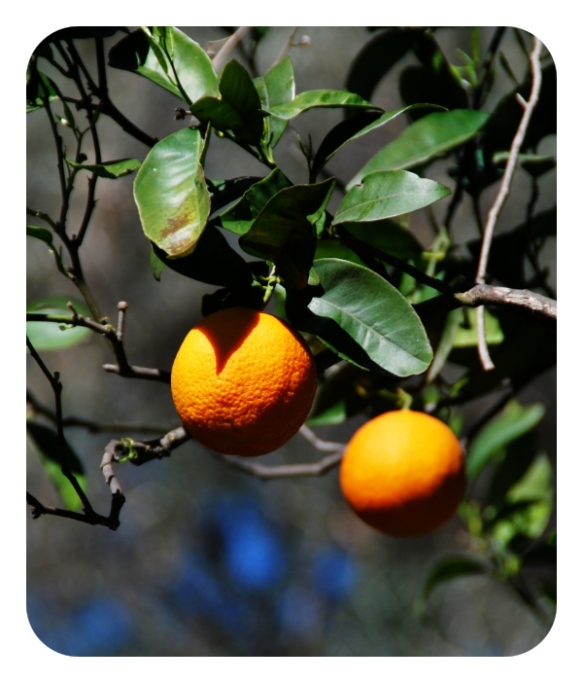
Object 1: An Orange

Object 1: An Orange

And where better to start than an orange? This particular citrus was photographed hanging in the garden of the casita which we rented for a week, in the Apuljarras, Andalucia, Spain.

It’s an orange remarkable not just for the novelty of seeing it on a tree rather than in a supermarket, but also for the fact that it witnessed myself and Beckie, my fiancee, alive and in one piece despite driving on Spanish roads. Ok so Spain isn’t as bad as Central America (where it is common practice to overtake on a bend with simply a hoot of the horn to warn oncomers), but the key difference is that we were behind the wheel, not a grizzled amigo, no stranger to RTA roulette, as was the case when we were travelling in Central America. The casita was deep in the Sierra Nevada mountains and we had no choice but to drive there ourselves. Although actually it wasn’t the mountain roads which were the challenge: it was Malaga.

ARRIVING AT Malaga airport we found the free shuttle bus to take us to our ‘budget’ car hire firm, a short five minute drive from the terminal where all the well known car hire firms were. “Solo mi hoy,” our driver told us as he threw our bags into the back of the minibus and ran around to jump in the driver’s seat. “Arriba arriba!” he shouted as we struggled to do up our belts and he accelerated up to 100 miles per hour. I was glad that Beckie had volunteered to be the first to drive on account of me having a sprained ankle.
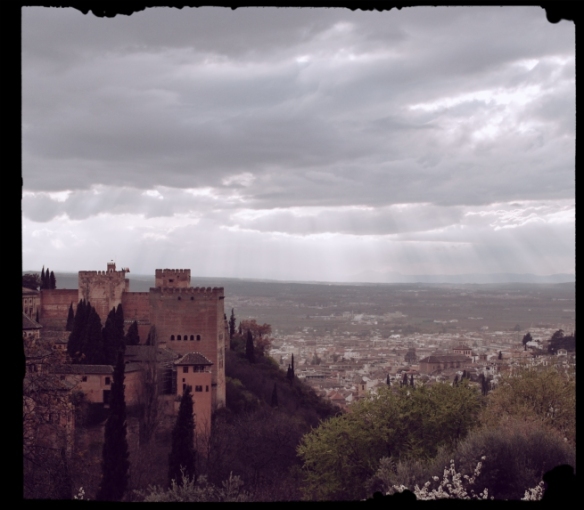
Exactly what Malaga doesn't look like. In fact, this is the far lovelier city of Granada, where we stayed for the first week of our Andalucian adventure. That's the Al Hambra in the foreground, largely considered to be one of the must see historical buildings of the world. It rained every single day we were there.

Exactly what Malaga doesn’t look like. In fact, this is the far lovelier city of Granada, where we stayed for the first week of our Andalucian adventure. That’s the Al Hambra in the foreground, largely considered to be one of the must-see historical buildings of the world. It rained every single day we were there. I don’t care if it was a once in a life time cultural experience: I still got wet. I get enough of that in London.

“So,” said the woman at Nisa car hire when we presented our documents, “the insurance that you have covers the wheels and the bottom of the car, but none of the windows or body. Do you want to take out full insurance? It’s six euros a day.”
“Si, si. Definitely. We want the insurance. Por favor.”
“Good,” said the woman behind the desk, “because your car’s covered in scratches already, so it’s hard to find the new ones when you bring it back in.” I smiled encouragingly  at Beckie, and endeavoured to limp a little more convincingly.

“Drive on the right, give way to the left,” I told Beckie as she pulled out of the car hire firm at about two miles per hour onto a roundabout where Spanish drivers were hurtling about with little regard for life or death. Encouraged by my advice from the passenger seat, she navigated our battered car through the streets of Malaga. “That’s good, that’s very good, now remember to give way to the right, yes, that’s it, you’re quite close to the curb now. Really close to the curb. Watch out for that… really close REALLY CLOSE.  You’re going to HIT IT! Ok good, well missed. Ok we also just missed our turning. No I wasn’t looking at the satnav either.”
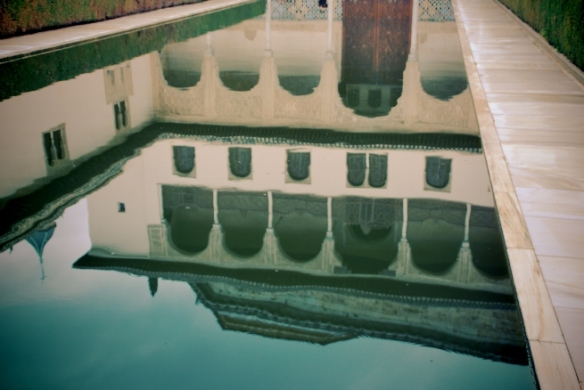
Part of the Al Hambra. I mainly took this picture to demonstrate that it had stopped raining, however briefly.

Part of the Al Hambra, an amazing Moorish building of incredible architectural and cultural significance. I mainly took this picture to demonstrate that it had stopped raining.

Despite my prophecies of doom as we drove along, Beckie did a fantastic job of getting us to our hotel. I certainly would not have done it so calmly. We arrived successfully at the hotel to find an empty car park.

“Good, now just put it in one of the spaces.” I was starting to get the hang of this driving thing. However, after Beckie had five attempts to put the car in a space – driving forward, then back, then forward again to straighten it up – I was starting to think that my cheerleading from the passenger seat was ineffective. Then the receptionist from the hotel came out. “Please,” she shouted, “for the love of God, stop reversing!” You’re the only people in the hotel tonight, it doesn’t matter where you park.” The two of us were silent for a moment. “Well, I think that we did a really good job there,” I said, nodding, “good reversing.” Beckie gave me a look that confirmed my suspicions about what added value my driving advice was bringing. We had arrived on holiday.

Evidently it didn't rain in Moorish Spain, as there were holes in the roof of the Al Hambra.

Evidently it didn’t rain in Moorish Spain, as there were holes in the roof of the Al Hambra.

We were in Malaga for one night only, before moving onto the lovely city of Granada. I have blanked most of that journey from my mind, but I do still occasionally get flashbacks to the bit where we ended up in a pedestrianised part of the city and had to slowly inch our car through crowds of people before dropping off the curb and back onto the road. Granada: I love you, but what is going on with your road system?

I won’t rehearse our week in Granada, save to to say that IT RAINED. I may already have mentioned that. Next stop: Las Alpujarras.

OUR CASITA was at the end of an unpaved road, which we inched along at about 5 miles per hour, rocks flying everywhere. We were deep in the Alpujarras, near the town of Orgiva – and, yes, the sole reason that we had come here was because we had both read and loved Chris Stewart’s Driving Over Lemons, an account of how he and his wife had moved to the Alpujarras and bought a farm. On our way down the rocky track we passed some workmen digging a hole by the side of the road. I nodded to them in a manly fashion, I hoped giving the impression that I knew where I was going and that every day I drove over uneven ground in a totally inappropriate car. They didn’t nod back.

Remarkably, we arrived at the Casita in one piece: the rain had gone, the sun was shining and the sky was blue. Our garden looked like this:
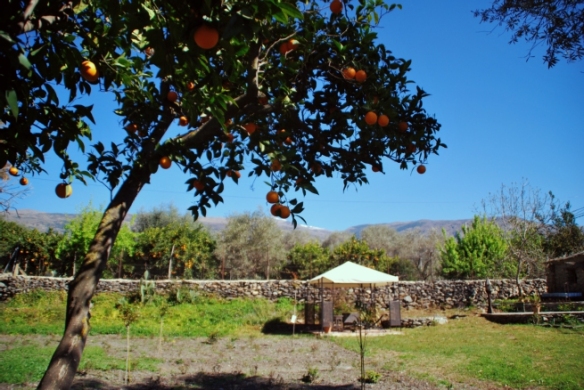
Oranges! In a tree! In our garden! That's what travelling is all about.

Oranges! In a tree! In our garden! Surely this is what holidays are all about?

My guide to making your very own orange juice:
First: collect your oranges.
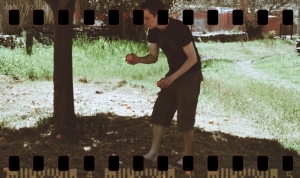
First: collect your oranges.

Select only the best ones.
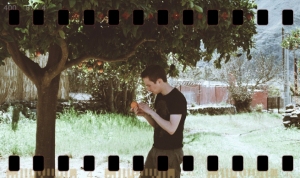
Select only the best ones.

It's ok to eat oranges from off the floor, right? There's no three second rule or anything? Don't worry if they're dirty. It probably won't kill you.

It’s ok to eat oranges from off the floor, right? There’s no three second rule or anything? Don’t worry if they’re dirty. It probably won’t kill you.

Be wary of buzzing things in the tree above your head. It could be a bee. A killer bee.

Be wary of buzzing things in the tree above your head. It could be a bee. A killer bee.

It's a killer bee! Panic! Panic! Remember: don't drop any oranges when you run away like a girl.

It’s a killer bee! Panic! Panic! Remember: don’t drop any oranges when you run away like a girl.
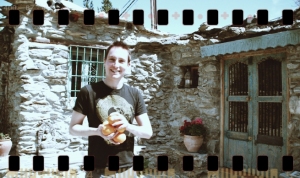
Don't worry, if you didn't drop any oranges then it's ok, you didn't look that stupid. If you did drop oranges: return to step 1.

Don’t worry, if you didn’t drop any oranges then it’s ok, you didn’t look that stupid. If you did drop oranges: return to step 1.

Next: cut your oranges in half. Getting bored yet? Don't worry if not, you soon will be.

Next: cut your oranges in half. Getting bored yet? Don’t worry if not, you soon will be.

Now, squeeze your oranges. By now you should be beginning to wish that you'd just bought some orange juice from the shop.

Now, squeeze your oranges. By now you should be beginning to wish that you’d just bought some orange juice from the shop.
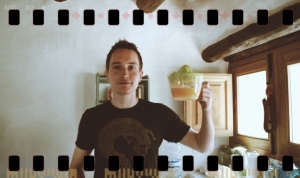
Well done! You've successfully navigated the perils of killer bees, looking like a moron, and repetitive strain injury to deliver one glass of orange juice.
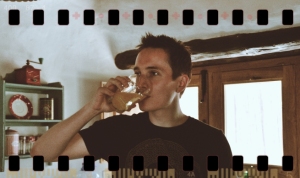
Well done! You’ve successfully navigated the perils of killer bees, looking like a moron, and repetitive strain injury to deliver one glass of orange juice.

Finally: drink your juice! Refreshed? Good, because someone else probably needs a glass as well. Return to step 1. Remember to remind yourself that you're on holiday.

Finally: drink your juice! Refreshed? Good, because someone else probably needs a glass as well. Return to step 1. Remember to remind yourself that you’re on holiday.

We spent five blissful days sitting in the sun and reading. It’s lucky that we didn’t want to go anywhere, as the morning after we’d I’d arrived we walked up the dirt road to go to the town. About half a mile up the road – the sole access to the Casita – was a hole, dug by the workmen that I’d nodded to the day before. It stretched across the entire road. We were able to walk past it, but there was no way you’d get a car past. It was Saturday, the day before Easter Sunday. There wasn’t a single workman in sight. Whilst we were staring at the hole, a local resident struck up conversation with us. We told him that we were leaving on Wednesday. “Don’t worry,” he said, “I spoke to the workmen yesterday. They said that they’re probably going to fill it in by Tuesday.” I shrugged, as is the Spanish way, put it to the back of my mind and went to the shop to buy some orange juice.

On the penultimate day, there was a power cut. We noticed because the beer wasn’t cold in the fridge. It was a minor disaster, but we soldiered on. That evening, we lit candles. It was romantic. We did note that the other casitas further down the road seemed to have electric lights, but thought no more of it. On our final day, we were still without electricity, so we called the owners of the Casita, who (of course) lived in England. Was it the fuse box that had gone? No it wasn’t. What could it be? They arranged for a handyman to come out and have a look. About an hour later, a small German arrived on our doorstep. He looked at the fusebox. He looked at the electrics. Then he went outside to the road, where the electricity meter was housed. “Aha!” He shouted, when he opened it up. “Here is your problem! You have no electricity meter. They have come and taken it away!”
“Who has?” I asked.
“The electricity board of course.”
“But why would they do that?”
“Well, the owners must be not paying the bill for this to happen.”
“Right.”

That night we had candles again. It was less romantic.

Still, we left the next day refreshed and rejuvenated in a way that can only be achieved by time away from home. This lasted half a mile, until we reached the hole in the road. Which was still there. A large man in a hard hat and a high vis jacket stood next to the hole, his belly poking out from under his T-shirt. He idly watched me inch the car up to the hole. I stopped and wound down the window.
“Is it possible to drive over?” I asked, in my broken Spanish.
He looked at the car, he looked at the hole.
“Si,” he said.
“Are you sure?” I asked.
“Si!” He nodded more vigorously this time.
I folded in the wing mirrors, hugged the car to the wall and started to inch across the remaining strip of road, my friend in the high vis jacket gesturing me onwards.
I nearly made it, but for the fact that my back right wheel fell into the hole with a bang. This didn’t deter Mr High Vis though. No, he manfully got behind the car and pushed, whilst I desperately revved, aggressively spun one of my wheels and generally covered him in dirt. And then suddenly there was traction, and we were away! We left the workman behind us in a cloud of dust. I gave him a cheery wave out of the window, shouted my thanks and was silently grateful that we’d taken out the extra insurance on the car. Thank you Mr High Vis. Sorry about covering you in dirt!

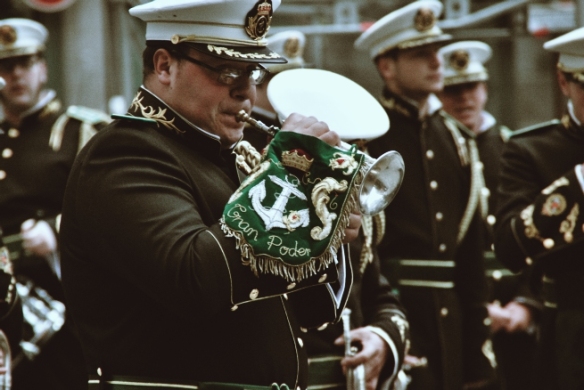
PERHAPS THESE stories don’t reflect the culture, history and learning that we experienced on our trip to Andalucia. And there was plenty. From marching bands:
orange19To people in silly hats:

orange20

But sometimes when you travel, it’s the mundane that sticks in your mind, the familiar things that you end up doing differently. And for me, Andalucia was all about getting my orange juice in the morning.
The End of Autumn in Cumbria: Or, How I Am Not A Country Boy

Sheep Sign

“I THINK that it’s going now,” I said, staring at the wood burner. Behind the glass sat a stack of kindling, gently smoking. There were no flames. “Yup,” I nodded, more hopeful than believable, “definitely going.”

I was in a small self catering cottage in the tiny village of Maulds Meaburn, East Cumbria, in the North West of England. In a manner completely unfitting of someone who attempts to maintain a travel blog, this was the third time that my fiancée and I had stayed there. How did that happen? I blame London. We’d both been working crazy hours, and as the long-booked week-off crept closer, everything seemed too much hassle. It wasn’t that we wanted to do something easy, it was that we wanted something edifying for the soul; some peace and solitude away from walking up escalators on the left hand side; some peace and solitude away from the hiss of bendy buses’ doors, endlessly swallowing commuters; some peace and solitude away from the six inches of dirty grey seat where, if I’m lucky on my train journey into work, I might attempt to place my backside inbetween two impossibly large people seated either side, one of whom is inevitably listening to One Direction on their ipod at 600 decibels.

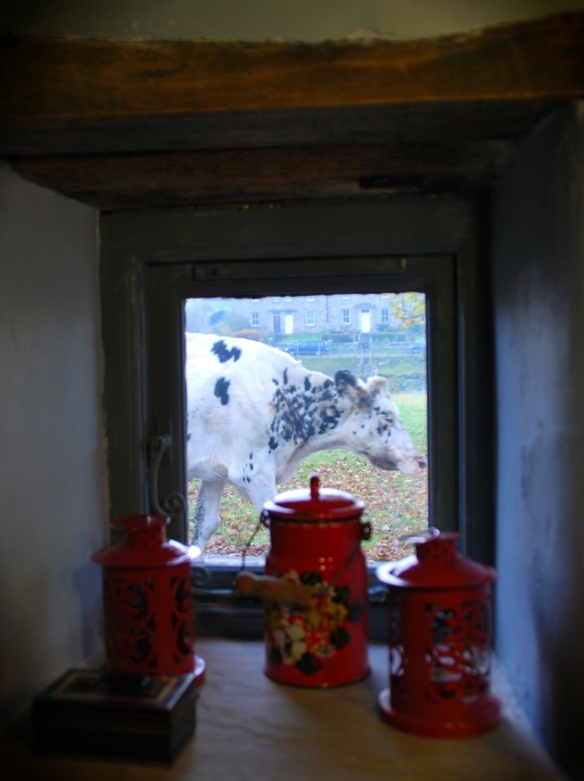
And what could be more edifying than this view from your window every morning?

The funny thing about this photo is that moments later the seven year old girl who was herding these cows (apparently they start them early in the farming world) walked past and looked straight at me, the lunatic London man up for the week and taking pictures of cows out of his window. I can only imagine what she thought. When she and her cow walked past on other mornings, I was altogether more furtive in taking pictures. This probably did little to help her impression of me when she caught me a second time. Somewhere in East Cumbria, a small child thinks that a bad private detective is on her tail. Either that or she thinks that all Londoners are morons.

The funny thing about this photo is that moments later the seven year old girl who was herding these cows (apparently they start them early in the farming world) walked past and looked straight at me, the lunatic London man up for the week and taking pictures of cows out of his window. I can only imagine what she thought. When she and her cow walked past on other mornings, I was altogether more furtive in taking pictures. This probably did little to help her impression of me when she caught me a second time. Somewhere in East Cumbria, a small child thinks that a bad private detective is on her tail. Either that or she thinks that all Londoners are morons.

The first day of our stay in ruralville was a bright, cold day with clear skies and not a single bendy bus in sight. We resolved to make the most of the fine weather, the country air and the peaceful tranquility. So we went to the pub.

Yes some people might see this as a missed opportunity to hike up a mountain, but we saw it as an important opportunity to visit the heart of this small community. And drink some beer.

We didn’t waste the short walk to the nearest (and only) drinking establishment, either. It was about a mile. It took us an hour and a half, on account of the fact that I had my camera  and Beckie had her foraging book. Our journey was therefore punctuated by me doing a passable impression of paparazzi to the countryside, and Beckie failing to identify the various fauna we passed on our way (“Is it fat hen? I think it might be fat hen.” “Great, what can you use it for?” “The book says it’s good in salads, but some types are poisonous.”).

This is what we saw:

The deepening shadows of shortening days.

The deepening shadows of shortening days.

The way autumn leaves gather together in rushing water.

The way autumn leaves gather together in rushing water.

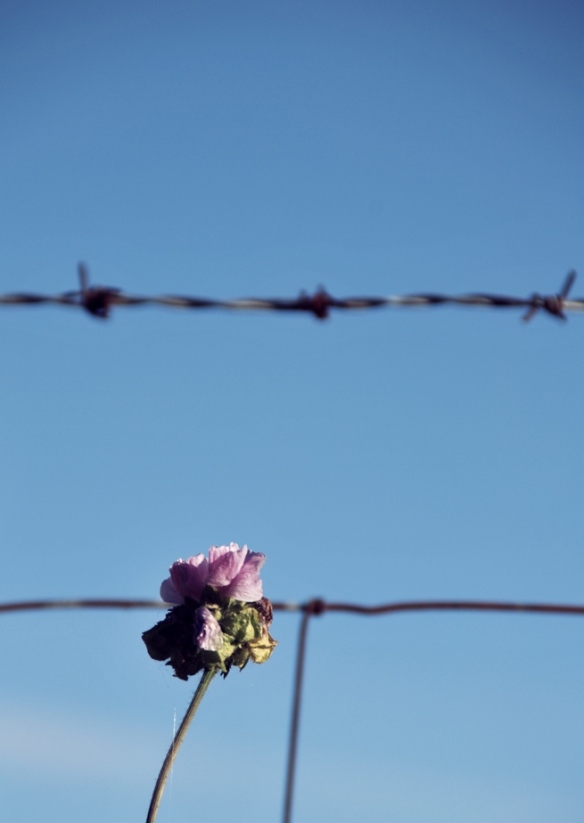
The contrast of metal and petal.

The contrast of metal and petal.

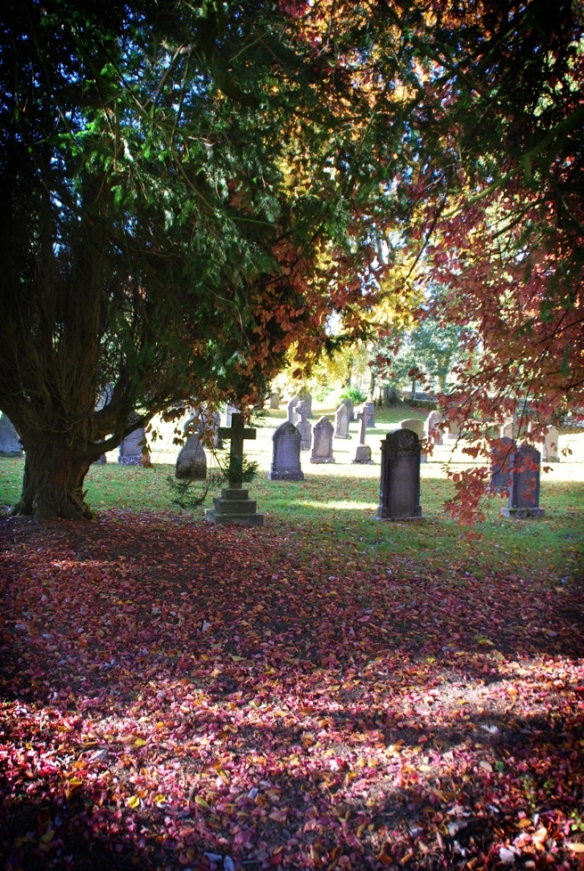
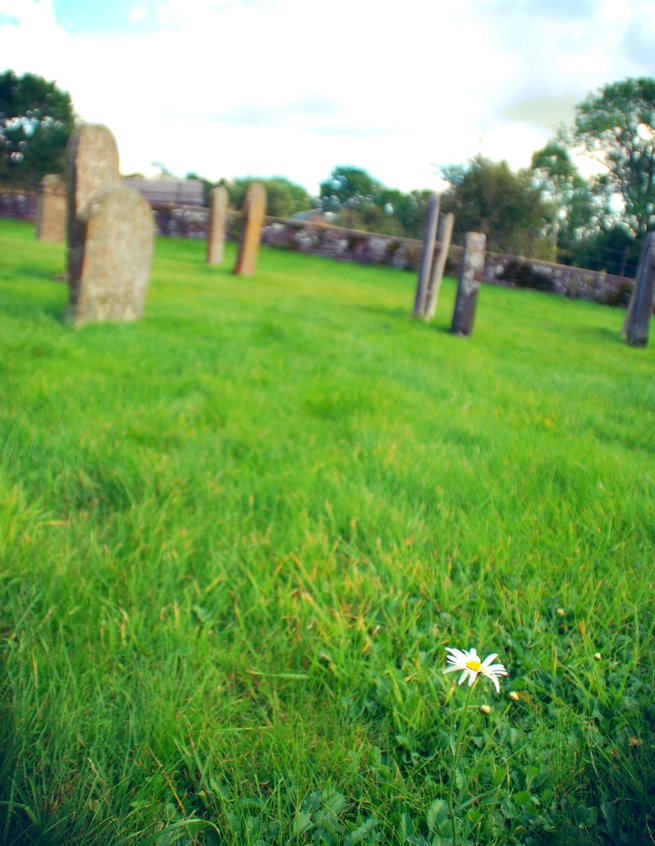
A cemetery coloured by dead and dying leaves. Actually, I really had to resist the urge to inspect the graves here: as longer term readers of this blog will know, I have developed a habit of photographing old headstones. I'd already convinced one local seven year old that I was A Bit Weird. No need to make the good people of Maulds Meaburn think that I was also A Lot Creepy.

A cemetery coloured by dead and dying leaves. Actually, I really had to resist the urge to inspect the graves here: as longer term readers of this blog will know, I have developed a habit of photographing old headstones. I’d already convinced one local seven year old that I was A Bit Weird. No need to make the good people of Maulds Meaburn think that I was also A Lot Creepy.

Eventually, we reached the pub.

The Butchers Arms is a community pub in the tiny village of Crosby Ravensworth. When the oub closed down several years ago, the local community grouped together, bought the pub and refurbished the place.

The Butchers Arms is a community pub in the tiny village of Crosby Ravensworth. When the pub closed down several years ago, the local community grouped together to buy and refurbish it. On the walls there are pictures of the Prime Minister in front of the pub, from when he came to open it as a shining example of Big Society in action. We arrived just after the kitchen had closed, so we lunched on roast chicken flavoured crisps and a local ale. Whilst we were there, lots of locals in funny socks and funnier hats arrived for what appeared to be a post-hunting knees up. Or it could have been that they had been Morris Dancing. Or maybe they always dress like that on a Saturday? Who knows: it was a mystery. We hunkered down in the corner and tried to look casual. I decided not to tell them that they’d missed an apostrophe off the name of their pub.

All in all, going to stay in a tiny village in East Cumbria made me feel overwhelmingly urban. It’s strange the feeling of otherness that you can experience in your own country sometimes; I find this especially so considering that I live in a cosmopolitan city which has most nations on earth represented in its inhabitants.

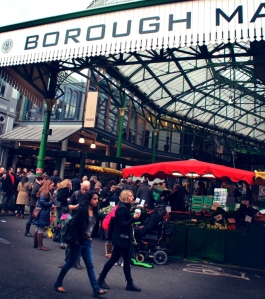
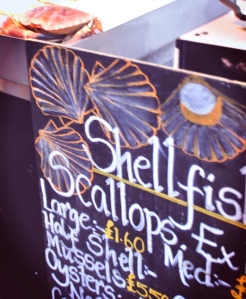
A FEW weeks later I found myself in Borough Market – one of London’s busiest and best known food markets. People jostled me, I jostled people. I joined the crowds wandering from stall to stall, searching for the ultimate, most satisfying, most outrageous lunch. Elk burgers?  Exquisite sushi? Slow cooked rabbit? Caribbean curry? Scallops the size of my hand? This is what Borough Market is about: the choice, the quality and, of course, joining the biggest queue possible because that’s surely where the best food must be, right? ThisIsLondon. This couldn’t be more different than Cumbria.

Something witty

Enormously busy, discerning and important foodies charge around Borough Market, tutting at idiots with cameras who get in their way and opining on the best place to buy organic veg. Through a popular process known as ‘queueing’, they then assemble in lines to work themselves into a feeding frenzy.

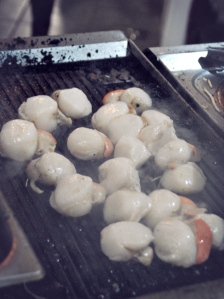
So that's what I'd been queueing for! It's always a relief to get to the front of a queue and discover that it's all been worthwhile.

So that’s what I’d been queueing for! It’s always a relief to get to the front of a queue and discover that it’s all been worthwhile.

Something witty

The sign tells you that the prices are eyewatering, but it’s too late now you’re at the front of the queue. You’re not going to quit now, are you?

Wit

Seating is few and far between in Borough Market. Those victorious sit and laugh at the standing. It’s cut throat.

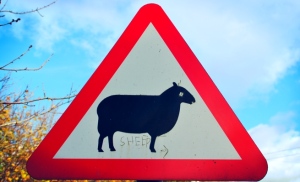
By contrast country life is, I feel, of a slower pace, with different concerns. There were a few signs, in particular, that I came across in Cumbria which made me feel alien to this land.

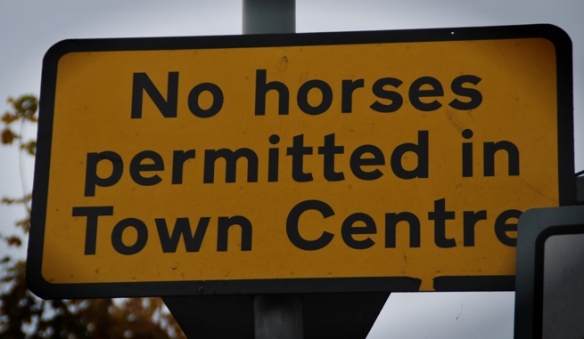
I didn't see any horses in the town centre, but evidently this has been enough of a problem in the past that the local authority felt the need for a sign.

I didn’t see any horses in the town centre, but evidently this has been enough of a problem in the past that the local authority felt the need for a sign.

What does the Red Squirrel Ranger do to any grey squirrels that he finds? And does he ride a horse?

What does the Red Squirrel Ranger do to any grey squirrels that he finds? And does he ride a horse?

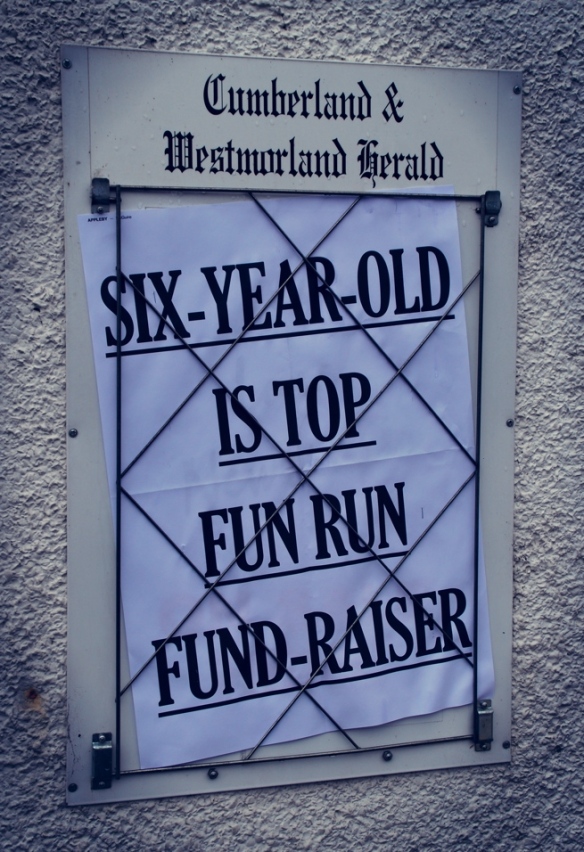
Slow day on the local paper, or big news? I had no way of telling.

Slow day on the local paper, or big news? I had no way of telling.

It’s easy for me to mock to these signs; perhaps people who live in East Cumbria do too. Taken together they give the impression that not a lot happens there, that in some way East Cumbria is a fragment of the past in the modern day. That’s not true, of course, but it’s easier to mock something for its strangeness than it is to understand difference. And my week away in the beautiful village of Maulds Meaburn has convinced me that there’s lot I don’t understand about rural life. I am not a country boy. I probably knew this deep down, but travelling to this place where I’ve been before, in my own country, and yet experiencing otherness has caused me to re-evaluate how urban I am. It turns out that I like the city.

Home. I guess.

Home. I guess.

But I also dream of living in a place like this:

brew16

So how do I square these two desires? Am I a cityboy who wants to live in the country? Is it possible to have one foot in both? I’m not sure, but if I hadn’t visited Maulds Meaburn I wouldn’t have been thinking these thoughts. I suppose that the message to take away is that travel, even to somewhere you supposedly know, makes you think, makes you look at the way you live your own life.

But it turns out that I may not be alone in my city/country divided self: we like staying in East Cumbria because it’s less crowded than the rest of Cumbria, i.e. the Lake District. And the problem with the Lake District? It’s full of people from London.

I am, however, one step closer to becoming a country boy: I lit the fire! It only took four days of trying.

I am, however, one step closer to becoming a country boy: I lit the fire! It only took four days of trying.

When Cardiff is like a Film Noire

THE TRAVELODGE that I stayed in was wonderful. Or it would have been if I’d been on a Stag weekend (that’s Bachelor Party to North American readers). It was not the right choice for a business trip.

Cardiff is great city. Friendly people, good shopping, great nightlife, beautiful surrounding countryside. A good place to hang out. I know all this because I have been there before. And for that I am grateful, because otherwise I would have a very dim view of the city indeed. A dim view based on limited factors it’s true, but when travelling to a new place sometimes all it can take is a friendly smile or a snide remark to shape your view of a place. Even with an open mind, a catalogue of these things can turn you into a falling domino-line of judgement, seeking the swiftest escape possible from a place. Frankly, if the quickest way to leave Cardiff had been, through some weird timewarp, to paradrop over Normandy in 1944, I’d have given it some serious consideration.

Red leaves, reminiscent of the red scales of the welsh dragon… a tenuous link? You bet it is. I have no photos of my 24 hours in Cardiff, because a) I didn’t have my camera with me and b) I wanted to forget it. So instead, you have these calming pictures of autumn taken in Oxleas Wood, Welling, London, yesterday. As my blood pressure was rising in Cardiff, this was the happy place I went to in my mind.

So. The Travelodge. I arrived in Cardiff at about 8.45pm. I was initially misdirected by a taxi driver (“you don’t need a taxi, it’s that building right in front of you.” No it wasn’t. But you can’t go back to the taxi rank once you’ve been given directions, never mind how wrong they were. You’ve just got to forge ahead regardless. Otherwise you’re not just a clueless tourist but stupid too. I’m pretty sure that’s the law). It was raining.
I tramped through the centre of Cardiff to my hotel. I passed takeaways and pubs, clubs and bars. Sure, there were loads of other shops, but it was nearly 9pm and they were all closed, their shopfronts dark. Through the drizzle, it seemed like the only thing in Cardiff was booze. As I passed girls in six inch heels and six inch skirts, I felt like an extra in a government sponsored binge-drinking awareness advert.

Autumn leaves are highlighted by a shaft of October sun, slanting down exactly like sunshine doesn’t in Cardiff.

I arrived at the hotel, which was situated “in the heart of Cardiff,” i.e. on the busy main street packed with pubs and clubs, Queen Street. It was raining. I was wet.

How convenient, I thought, this would be if I were in a drinking mood. Not only is Cardiff’s vibrant nightlife literally on my doorstep, but the reception also doubles up as a bar. There were beer taps right there on the reception. Food was served 24 hours a day in a little room next to the reception (“it’s not just a restaurant, it’s like a takeaway place at the end of the night – all in the comfort of your hotel”). There were clear signs about how to behave, in several different languages (“WE WILL NOT TOLERATE ANY ABUSE OF OUR RECEPTION STAFF”). And when I’d checked in and arrived in my small, sparse but functional room, I was naturally overjoyed to discover that there was a bottle opener screwed onto the desk, so that I could enjoy some pre-loading in the comfort of my own room before heading on my fictional night out. And from the sounds of things I wouldn’t have to move far to experience the noise and atmosphere of a pub. In fact, I could enjoy these things sitting on my bed: the shouting was distinct and music spilled in from the window, ready to fill any uncomfortable silences.

I quickly changed and headed out into the rain again. The bright neon lights of a noodle bar dragged me through the darkness, its warm glow promising respite from the constant drizzle. I wasn’t eating alone in Wagamama’s, I was Deckard out of Blade Runner, moodily fuelling myself up before running down some simulants. I read my Murakami book (Kafka on the Shore, in case you were wondering), stared at my fellow diners and devoured a plate of yaki udon.

Then I headed back to the Travelodge. Since I had last ventured onto the dark streets of Cardiff, the heels had seemed to get higher, the skirts shorter, the walking more unsteady. Time for bed, I thought, to dream of electric sheep.

But as I sat in my room and listened to the music which had started up in the club next door, along with the serenading of “Surfin’ in the USA” which I was receiving from a Karaoke who-knows-where, I began to think that sleep may prove a little elusive…

…calming autumn colours in the sunlight. My Happy Place. There’s no stress here in the woods, no anger, only sunshine. No anger. No anger…

…so I went and complained. There was nothing they could do about the noise. Did they have any earplugs? A cursory glance in a box full of electronics gear ascertained that they didn’t have any. Not headphones, earplugs. Oh. No, they didn’t have any of those either. But wait! They did have some cotton wool. They bought it for the hoover, apparently (I never got to the bottom of why). But I was welcome to two cotton wool balls. Being British, I naturally thanked them for their time, apologised for troubling them and then retreated to my room.

THE COTTON wool balls didn’t work. The thing that they couldn’t stop was the way that the room shook with the bass from the club. That would have taken a lot more cotton wool, more even that they’d bought for the hoover. I was in a quandry. The thing is, the reception staff were actually really nice, helpful, and polite. But they couldn’t help me. This wasn’t their fault, I was just in the wrong hotel. What did I expect for £34 per night? Little men in bowler hats opening the door for me? I’d already complained once. The British thing would just be to put up with it, not to cause a fuss. The room shuddered in time with the beat. Rain splashed down the windows. What would Deckard do, I wondered?

So I did the most un-British of things. I packed my bags, told the reception staff that I was leaving and headed out into the night. What would Deckard do? He’d clearly book another hotel on Laterooms.com. And as I walked through the rain for the fourth time that night, I passed a group of about ten students standing around a busker, singing Champagne Supernova at the top of their voices:

Wake up the dawn and ask her why
A dreamer dreams she never dies
Wipe that tear away now from your eye
Slowly walking down the hall
Faster than a cannon ball
Where were you when we were getting high?

Amidst the darkness and the wet of dystopian Cardiff, the singing brought a smile to my lips, and I was happy that someone was having fun. I just wished that they’d do it a bit quieter. So I resolved to do that most British of things, and to write a strongly worded letter.

It’s a funny thing the way strange and beautiful life is found even amidst damp, darkness and decay.

Climbing the Stairs in Penrith: Or, Proving Larkin Wrong

I AM a control freak. I know this because I am always the one with the map, I am always the one cooking the roast, I am always the one who thinks that he’s got a plan. I tell myself (and others) that I’m being helpful, that I’m being organised. But I’m not. I am being IN CONTROL.

Does this look like a man in control? I’m actually holding on for dear life. Needless to say, this picture wasn’t taken in Penrith.

I know that this control freakery can be annoying for other people. I know this because my own father has stood over me before and told me how to butter bread the correct way. And I have found myself doing exactly the same thing with a friend chopping garlic (the mortifying thing is that it was also caught on camera: never has anyone ever looked so disapproving at another person for the way that they were chopping their garlic).

In This Be The Verse, Philip Larkin famously had this to say about what your parents give you:

They fuck you up, your mum and dad.
They may not mean to, but they do.
They fill you with the faults they had
And add some extra, just for you.

But they were fucked up in their turn
By fools in old-style hats and coats,
Who half the time were soppy-stern
And half at one another’s throats.

Man hands on misery to man.
It deepens like a coastal shelf.
Get out as early as you can,
And don’t have any kids yourself.

So it was with those cheerful words bouncing around in my head that I boarded a train destined for Penrith, where I would be joining my parents and family friends – let’s call them cousins and my aunt and uncle, because they’re the closest thing that I have to either: three generations in the same cottage for a weekend of eating, drinking and walking. What could possibly go wrong? A lot, Larkin would have me believe.

About an hour and a half into my train journey, somewhere around Wigan, I got a phone call from my dad:

“Dave, we’re at the cottage. But there’s been a bit of a calamity.”

“What is it dad, what’s wrong?” Is the kitchen flooded, I was thinking? Have they lost our booking? Has a tractor crashed into the car? Has someone broken their leg?

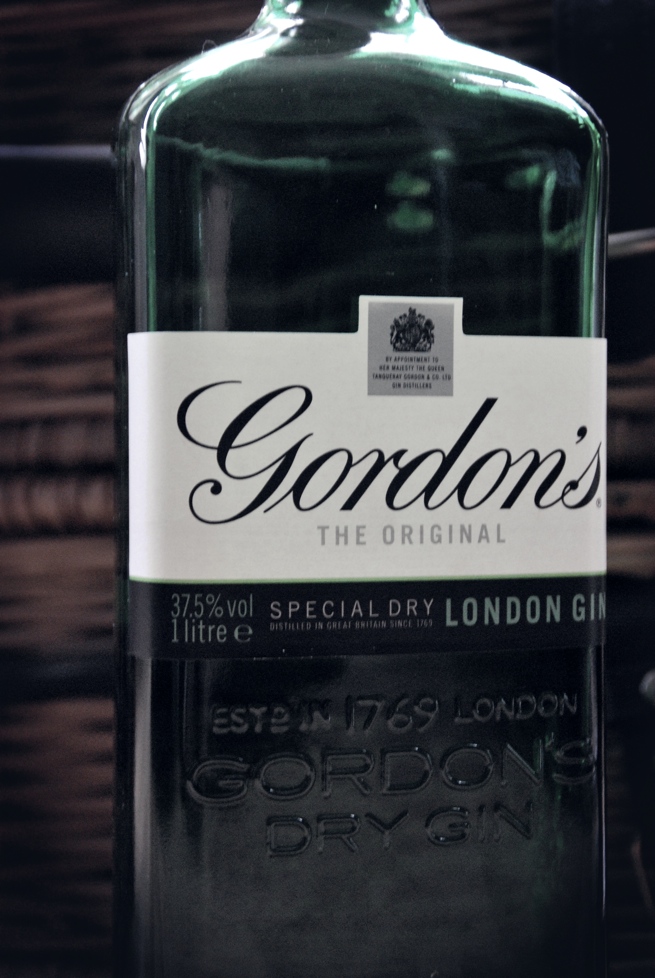
“It’s the gin, Dave. We forgot the gin…”

Fortunately, it turns out that they do have shops that sell gin in Penrith. What a relief! The wonderful bookend to the gin saga is, as we were leaving on the Sunday, my mother running up to me just as I was about to step out the door, an empty milk jug in her hand. “Dave, we’re staying on an extra night… Can you leave us some of your gin?”

So it really was remarkable when Saturday dawned and I didn’t have a hangover (I say ‘dawned’, but what I really mean is when I was woken up at about 9.30 on Saturday morning by my mother coughing loudly and not at all surreptitiously outside our bedroom door. It made me feel like a teenager again). I attribute this lack of a hangover to the youngest member of the party: Callum, aged one. Callum has, apparently, discovered stairs. He loves climbing them. I mean he LOVES them. Set free anywhere in the house and he would unerringly toddle off to the stairs, like a very slow, very drunken heatseeking missile with zero collision detection technology. Is that a duplo car to play with? It can climb the stairs with me! Is that a Mr Men book? I can throw it up the stairs…. Even sharing the task amongst ten of us meant a regular trip to the stairs to act as safety net/encouragement/carry-down-the-stairs. I don’t have a huge amount of experience with kids, but it turns out that you can’t be a control freak with them. An appeal to reason just doesn’t work with a one year old (“why are you climbing the stairs again? I mean, wouldn’t you rather play with your car… no, no, WHERE ARE YOU GOING?!”).

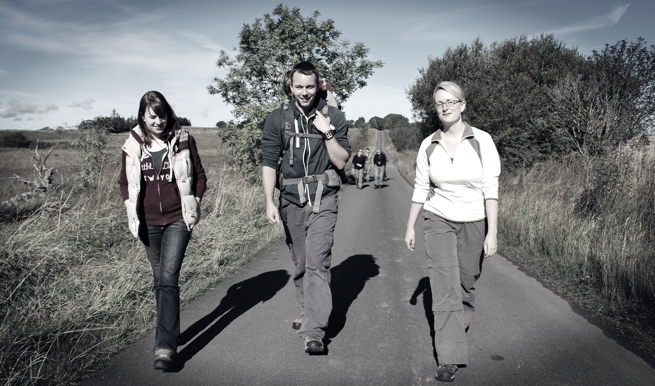
Here’s another place where my control freakery fell down. “What’s the plan?” I asked, when we eventually got up on Saturday morning, confident that the parental control freak and the certified twitcher would have it all in hand. “Go to the end of the road and turn either left or right, I guess,” was the reply. “You don’t even have a map?” “Yes, we have a map but we don’t really need one….” This lack of planning both worried and disturbed me. I went and laced up my hiking boots quietly in a corner (“we don’t have a map, we don’t have a map, we don’t have a map, it’s going to be ok, it’s going to be ok…”). This road was the right hand turn.

Which way? I don’t know, we didn’t have a map with us…

Summer’s last hurrah.

THERE CAME a point, when we were standing in a field, staring at a wall, when we had to admit that we were lost. After a brief discussion as to the merits of climbing over the wall or not, someone admitted to having brought a map with them (not me!). A brief consultation later and we headed out in the opposite direction.

Look, it was like this when we found it, ok? We certainly didn’t try and climb it.

Ok, so this gate was locked and we DID have to climb over it, but the map told us that it was a perfectly legitimate right of way…

It became clear to me why the gate was locked when these sheep began chasing us. There was something sinister in their coal-dead eyes as they pursued me across the field.

We escaped the sheep in one piece and made it back to the cottage for a spot of lunch/stair climbing. Somehow trekking through mud and over stiles seemed less draining than chasing after a one year old. So that afternoon some of us went for another walk to take a break from the stairs. We found a church:

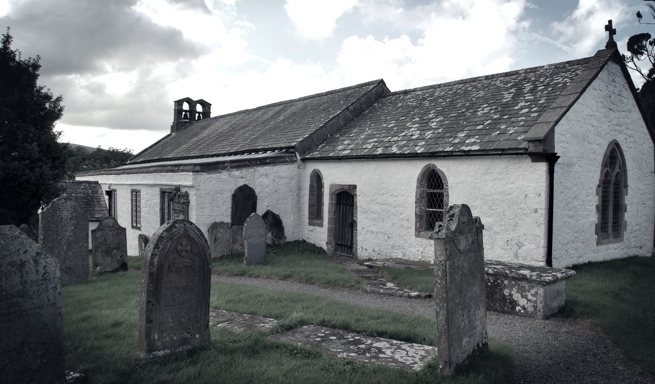
Those who have read this blog in the past might think that I make a habit of visiting graveyards to take pictures, but this was just a coincidence, ok?

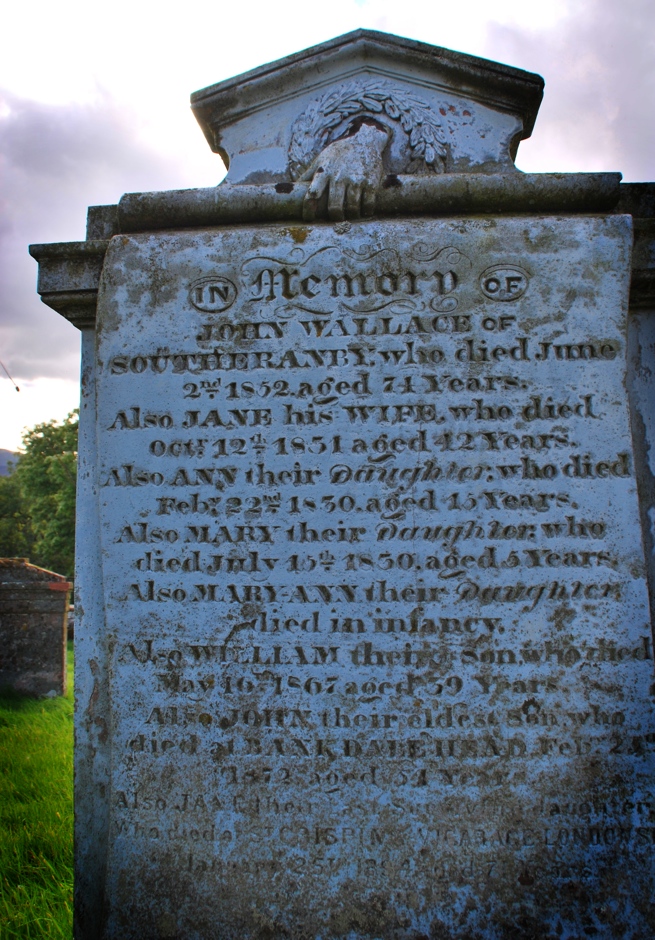
There is a morbid fascination in looking at gravestones, though. The older the better. But when does it become not ok to take photos of a gravestone? This graveyard was unusual in that it had some very old (1700s) gravestones and some very recent (2012) gravestones. As we entered the cemetery we exchanged pleasantries with a couple who had obviously just been to visit a grave. It’s not ok to take pictures of those graves. The basic graveyard rule of thumb, which I would commend to any budding cemetery snappers, is: if the headstone is still shiny, don’t photograph it.

Life over death.

Whichever way you look at it, it’s pretty creepy having a hand coming out of your tombstone.

After the thrill of the cemetery, we headed back to the cottage. Halfway back, we were met by Callum taking his dad, Steve, out for a walk. This time he’d chosen the buggy as his preferred mode of transport, rather than being strapped to his dad’s back (Callum can’t speak yet, but his cries of “choo choo! choo choo!” seemed to me to be a fairly unambiguous “faster, faster!”). I guess that I realised something then, but it didn’t click until later that evening when I was making dinner with Steve and his brother, Mat.

As previously discussed, I like being in control in the kitchen. So playing second fiddle to another chef required a lot of will power. I was smarting a little bit from criticism earlier in the day from Mat about the way I stacked the dishwasher (“stop, just stop Dave. That’s a spoon you’re putting an area clearly intended for knives”). It’s ok, I told myself, it’s ok – I’m still in control, even if I am peeling the spuds.

Operation Potato Peel went without a hitch, but then I started to wash the mushrooms and… all I can say is that Steve saw red. “WHAT ARE YOU DOING? Never, I mean NEVER,  wash mushrooms, they go all soggy…” As I stood speechless (why would mushrooms go soggy? why would anyone question my authority in the kitchen?) Callum entered the kitchen, his grandmother in tow. He toddled over to me and grasped my finger in his tiny hand, tugging insistently, and I was led out of the room in the direction of the stairs by a one year old child.

Perhaps, then, our parents do fill us with their own faults, but somehow I’m not buying Larkin’s assertion that it only leads to more misery. After all, Callum’s decisive – and dare I say in control – action averted mushroomgate.

You can walk ahead of your parents, but you’re still walking in the same direction.

Goodbye To All That: After the Olympics and the Paralympics

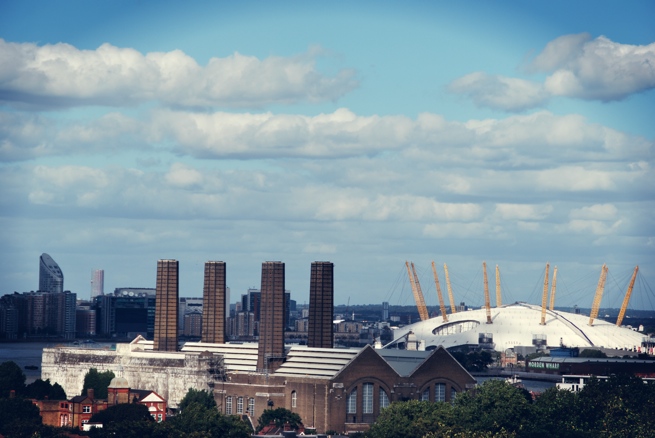
It’s called the O2 again.

TRY NOT to look for too much meaning in it all, those of us watching the Paralympics Closing Ceremony in the UK were told by the Channel Four commentators. That’s what the  director of the Closing Ceremony had reportedly been telling people. Try not to look for too much meaning in it all.

It’s got to be tough, coming fourth amongst all the ceremonies. I mean, the central London cityscape has been done to death. It’s in London, Big Ben’s there. We get it. There’s some music that Britain has made, and a bunch of other stuff (no real mention of Empire though, I noticed, or our imperial past – no Rudyard Kipling riding an elephant behind a group of redcoats massacring the natives, the survivors herded to a concentration camp from the country that invented them).

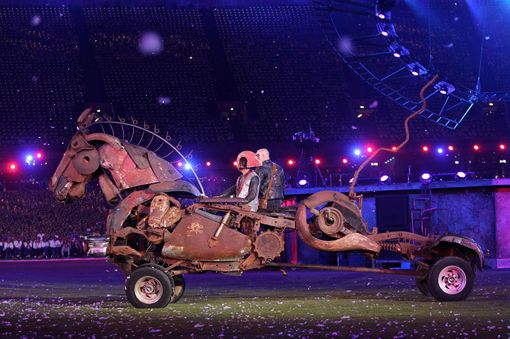
Instead the Paralympics Closing Ceremony seemed to focus on a vision of what London might look like after the apocalypse, if it had been turned into a giant Mad Max film set:

After over a month of Olympic and Paralympics, meaning had been spun out of the Games by countless column inches and broadcast hours – sporting, cultural, economic, historic. It had all been pored over. In London, even if you weren’t watching any of the events, it would be hard not to have seen the headlines and impossible not to have been in at least one conversation about Mo Farah.

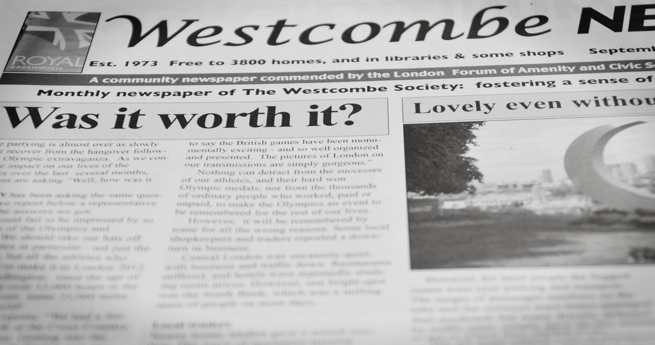
Even the Westcombe News (“Free to 3800 homes, and in libraries & some shops”) my local community newspaper and the home of rampant nimbyism, picked up the prevailing wind and realised that to come out openly against the Games would have resulted in their offices (if they had any) being stormed and the editorial staff (volunteers) being lynched in Greenwich Park. Still, as headlines go about the greatest sporting event that this nation has ever seen, “Was it worth it?” is hardly the unambiguous headline of unwavering support one might have expected.

The WN hedges its bets by first quoting random people saying how amazing the Games had been (including one from Sandra Barnes “writing from Philadelphia in the US” – you ran out of people in the area to say positive things and you had to go across the Atlantic to find someone else?). It then moves on to talk about the impact on local businesses (bad), the stationing of Rapier surface to air missiles near Greenwich Park (unforgivable, but “at least locals did not have them placed on their roofs”) and then transport: “the surges of passenger numbers on the tube and the railways were better managed than predicted [i.e. we thought we’d all be plunged back into the dark ages]: but many drivers, defeated by traffic jams, simply gave up any attempt to get to where they needed to be [i.e. I couldn’t drive to Sainsbury’s because of the one way system, so I gave up and came home]. They end with the standard disclaimer which now by law must be added when criticising any aspect of the Olympics: “Overall, most people agree that the games were a spectacular success.” This is journalistic gold.

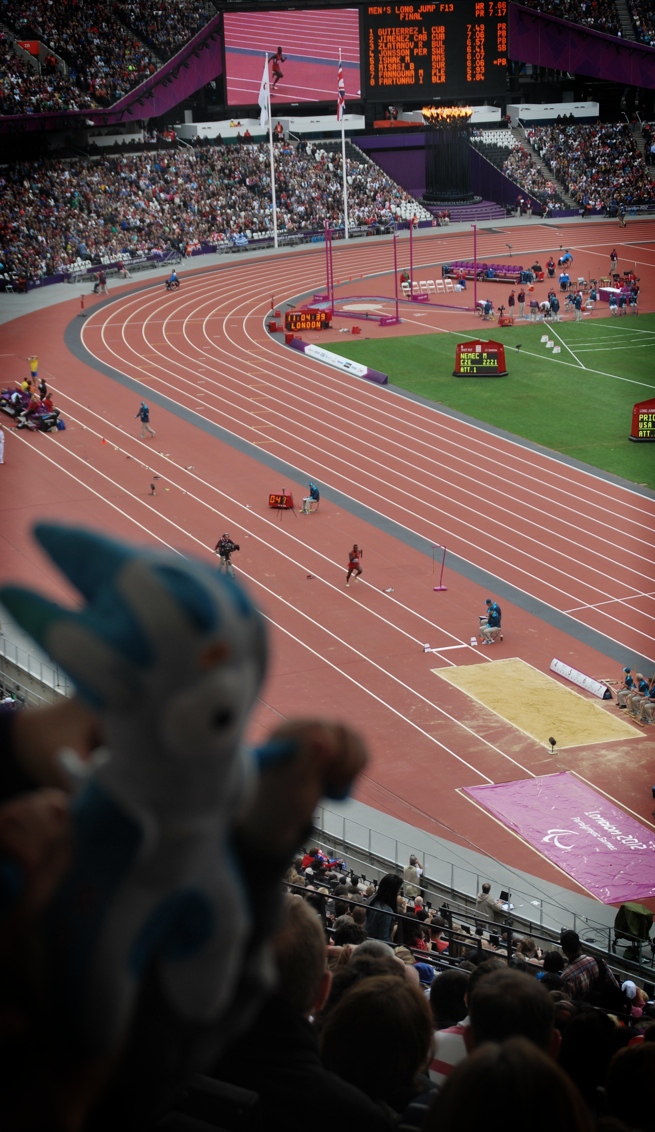
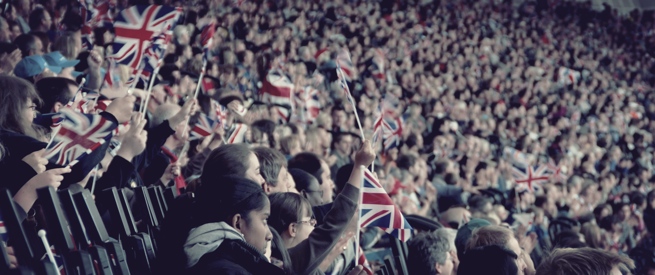
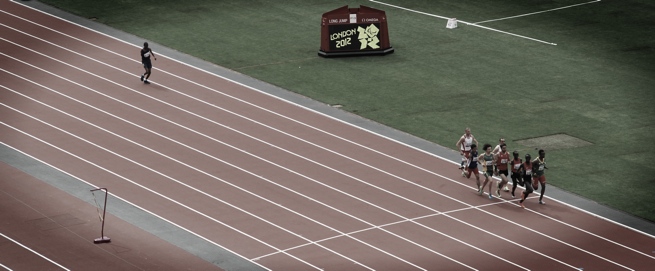
This is my photo and I was there. We’d been to the Olympic Park, of course, but hadn’t got tickets for the Stadium and utterly failed to get any tickets for the Paralympics. So receiving a phonecall from friends offering us two unwanted tickets to see athletics in the Stadium on a Saturday morning is in the same category as seeing people you know on the tube: impossible until it happens to you.

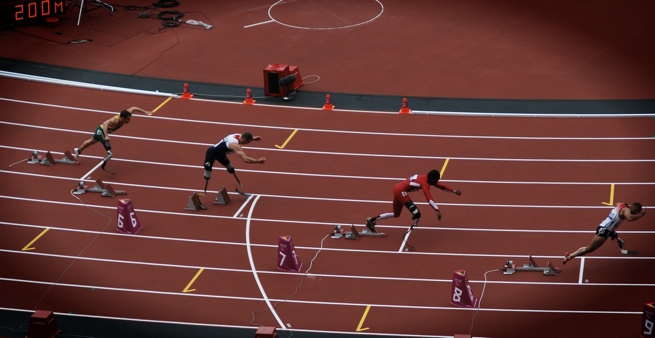
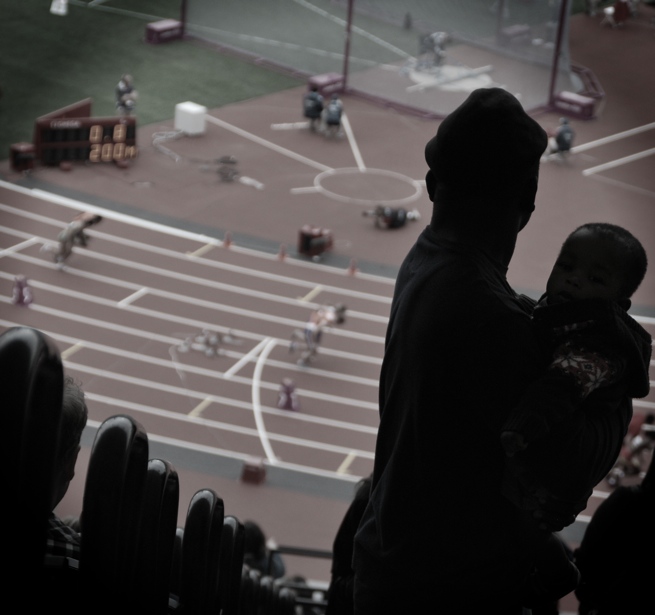
This is Richard Whitehead coming off the blocks in the men’s 200m final, just before he won gold for GB. Beckie, my partner, screamed herself hoarse during the race. I was slightly distracted because after taking this photo my memory card filled up, I couldn’t take any more photos, and I panicked. How will people know that I was here? I thought to myself. I can’t just see it with my own eyes! I hurriedly tried to delete photos. As it turns out, this takes longer than it takes Richard Whitehead to run 200m. Consequently, I actually missed him crossing the finish line. But I understand that it was very impressive.

This is how I know it was impressive. From the crowd’s reaction. That’s the wonderful thing about being in a crowd of 80,000 people. You really don’t need to do any thinking for yourself.

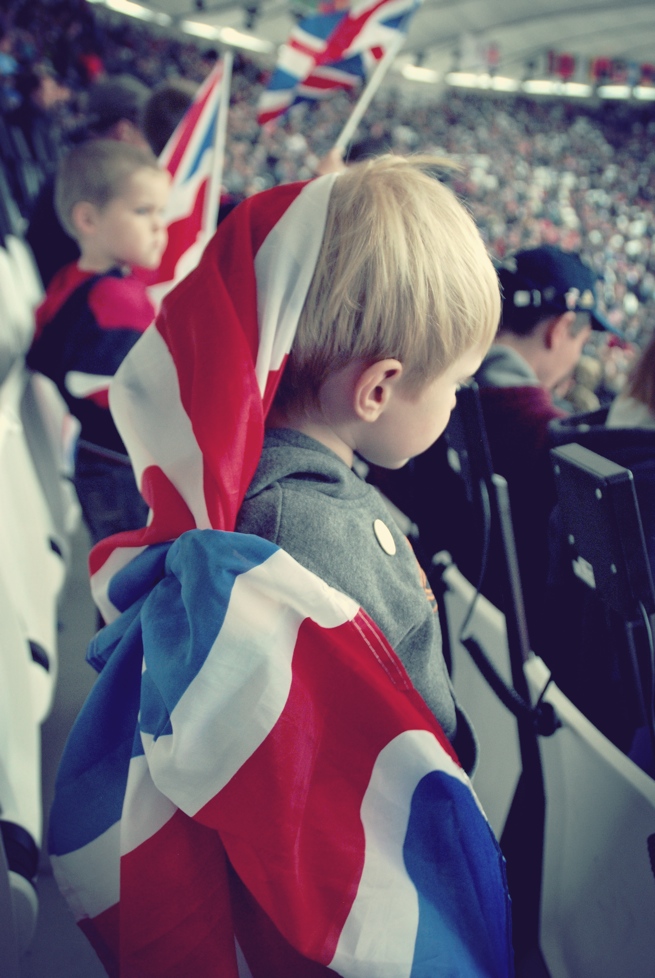
This kid was all about the flags, less about the sport. It would be wonderful if his name was Jack.

Some were more interested in the running than others.

During the Paralympics, there was a sense in London that the Olympics had been normalised. It was heralded as the biggest, most disruptive event since WW2 to hit the city, and yet everything had kept going. It felt like the city had absorbed the Games and moved on. There were still the pink shirted people at stations (not the same ever-cheerful volunteer Games Makers as at the Olympic venues, but dour, humourless people employed by the train companies just for the duration of the Games), still telling people to keep to the left. But, every morning, as the commuter crowd surged off my train and herded itself down the corridor to the barriers and the station exit, the calls of “guys, keep to the left,” fell on deaf ears. These were the same business-suited people who’d been walking on the right since before the Olympics, and would be doing it long after the pink shirts had disappeared. At North Greenwich station, the people handing out walking maps of the area (“why not walk? public transport is going to be very busy”) looked bored next to their human-sized piles of maps (I now have ten walking maps of Greenwich and Woolwich, all identical. I felt sorry for them every time I passed). And on the day after the Paralympics finished there was a ‘Victory Parade’ in Central London, and the Red Arrows flew past my sixth floor office window, spewing out patriotic clouds of red, white and blue. I was on the phone at the time, and I didn’t even mention it to the person on the other end.

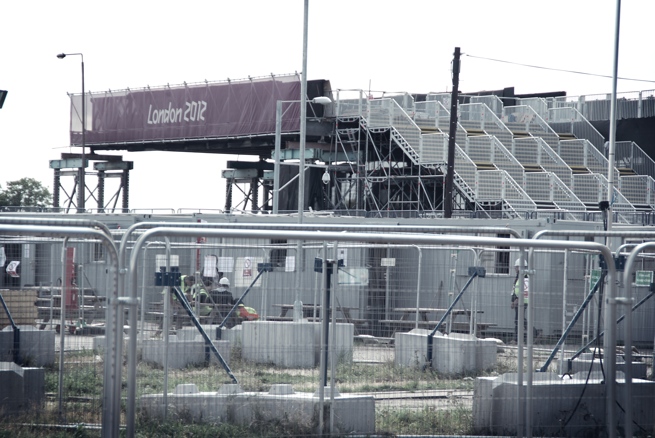
It’s just a building site now.

The Westcombe News will be happy.

Yes, London had reasserted itself. That brief, wonderful time when you could talk to strangers and they wouldn’t blank you was drawing to a close. It’s like when the snow melts every winter and people wake up to the fact that those people they’ve been joking with about slipping and sliding are actually just people-in-the-way.

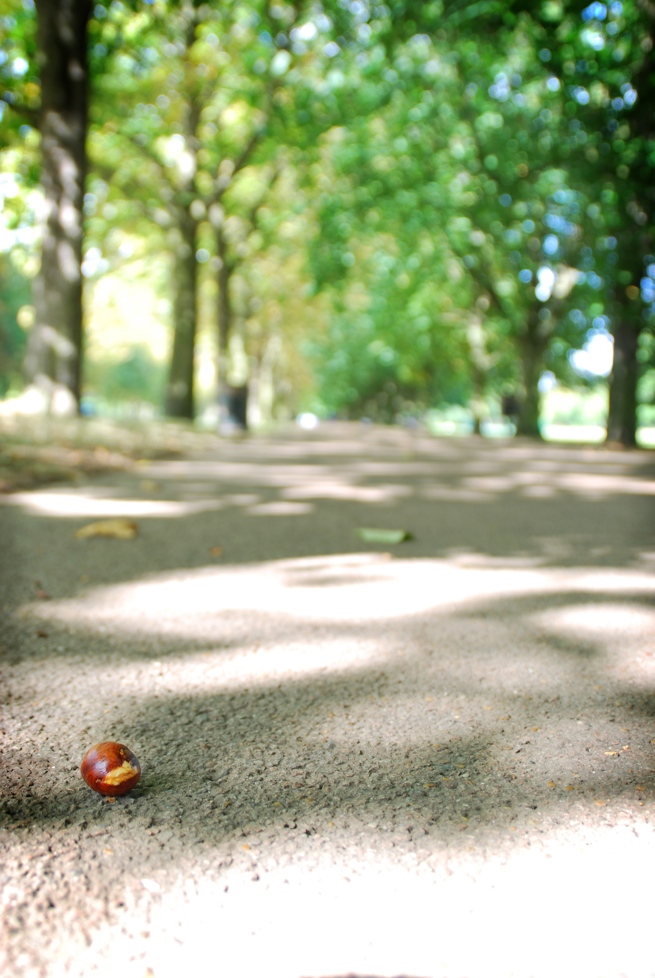
And with the closing of the Paralympics, the weather turned. After one last gasp of summer, the leaves began to fall from the trees, and conkers were trodden underfoot by the boots of the workmen dismantling the equestrian stadium in Greenwich Park.

Don’t be fooled by that sunshine. It’s autumn. Only downhill from here…

Sweet Chestnuts. In a few weeks’ time, when they’re at their best, Greenwich Park will be full of people sweeping these up into carrier bags. Don’t worry, though, you’ll see them again – when you pay £5 for a bag of them roasted, at a Christmas market.

So where is the meaning in all of this? Was it all, like the director of the Paralympic closing ceremony would have us believe, all spectacle to be consumed – like a bag of roast chestnuts bought at a Christmas market, a rare treat that we forget about until the next time? I will refrain from answering that question directly, and instead offer you what I’ll take away from the Games:

Omar Hassan of Djibouti. He was lapped twice by all the other competitors in the men’s T46 1500m race, and finished in 11m 23s – nearly seven minutes slower than his nearest competitor. At the end, he was the only man left running – or doing any kind of sport – in the Olympic arena, as 80,000 people got to their feet and cheered him on. At times it felt like he’d pack it all in (he was suffering from a foot injury, as it turns out), but he was there to the bitter end. “I thought of stopping,” he said afterwards. “But I kept going because I wanted to finish.” By far and away my best experience of either the Olympics or the Paralympics: a man who came last and registered one of the worst times in any major international championship, ever.